
EU-DRIVE brings disaster resilience to Paphos VET conference
Event
EUC-CERIDES showcases serious-game training and Quadruple Helix skills strategies at IDEP’s 2026 "Mind the Labour Gap" Annual Conference
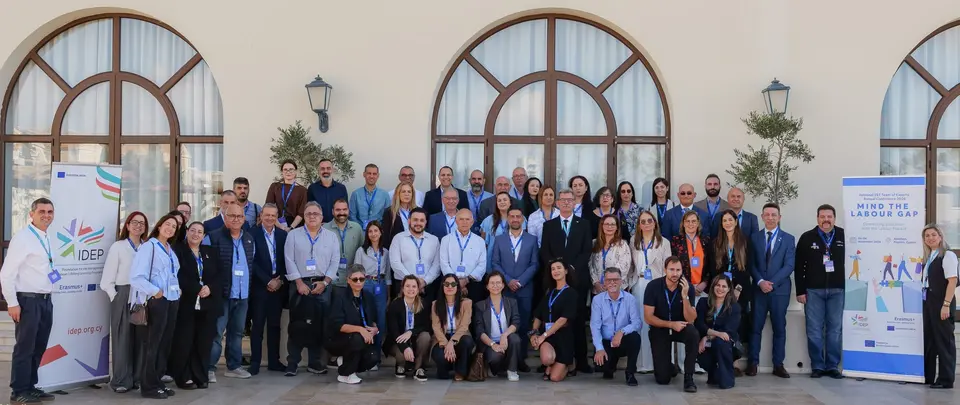
Paphos, Cyprus | 4–6 November 2026 — EU-DRIVE's coordinator EUC-CERIDES, represented the project in the National VET Team of Experts Annual Conference 2026, organised by the Foundation for the Management of European Lifelong Learning Programmes (IDEP), Cyprus’s National Agency for Erasmus+, at the Aliathon Resort in Paphos.
Held under the theme "Mind the Labour Gap: Connecting Education with the Labour Market," the three-day conference convened Vocational Education and Training (VET) providers, industry leaders, academic researchers, and policy stakeholders. Discussions focused on addressing emerging skills mismatches, integrating artificial intelligence and technological innovation into curricula, validating non-formal and informal learning, and advancing Centres of Vocational Excellence (CoVEs) across Europe.
Strengthening the Disaster Risk Management Skills Pipeline
Representing EU-DRIVE, Mr. Pierantonios Papazoglou from the European University Cyprus – CERIDES and Mr. Giorgos Fragkos from BK Plus Europe participated across all plenary sessions and hosted the dedicated EU-DRIVE exhibition booth. Visitors engaged with consortium representatives and explored dissemination materials designed by the project team of Nîmes Métropole, highlighting EU-DRIVE’s mission to establish a network of five regional CoVEs in climate-vulnerable regions (Cyprus, France, Greece, Italy, and Spain).
Interactive Parallel Workshop: Pyropolis Prepared
A highlight of EU-DRIVE's representation and EUC-CERIDES' contribution, was the parallel workshop led by Mr. Pierantonios Papazoglou, titled “Pyropolis Prepared – A Rapid Tabletop Role-Playing Workshop on Disaster Preparedness Decision-Making Trade-offs.”
Building on the Pyropolis simulative serious-game methodology, originally developed by EUC-CERIDES to foster participatory wildfire risk management and land-use planning, the session immersed participants in high-pressure, realistic crisis scenarios. Through structured role-play, attendees examined the transversal competencies required for effective Whole-of-Government and Whole-of-Society disaster preparedness.
Key Policy & Training Recommendations
The workshop concluded with a core set of recommendations aimed at aligning VET provision with real-world civil protection and climate resilience needs.
Recommendations included the establishment of joint VET and lifelong-learning curricula across the Quadruple Helix (academia, industry, government, and civil society) grounded in locally relevant disaster scenarios and lessons learned. Additionally, the prioritization of practical, human-centric skills alongside technical expertise to cultivate proactive safety culture, interagency coordination, interoperability, negotiation, digital and data literacy, and decision-making under pressure was also highlighted.
Finally, significant attention was given to the continuous collaboration and long-term partnerships amongst the key stakeholders. This would allow VET providers, employers, public authorities, and communities of practice to shift disaster risk management from reactive emergency response toward proactive prevention and preparedness, anchored by the "Knowledge – Composure – Discipline" triptych.
Funded by the European Union. Views and opinions expressed are however those of the author(s) only and do not necessarily those of the European Union or the European Education and Culture Executive Agency (EACEA). Neither the European Union nor EACEA can be held responsible for them.
