
Kick-off meeting of EU-DRIVE held in Nicosia, Cyprus
Event
Shaping the Future of Vocational Education and Training
EU-DRIVE (European Upskilling in Disaster Resilience and Innovation in Vocational Excellence) launched on April 28th and 29th, 2026. EU-DRIVE is an ERASMUS+ project co-funded by the European Union under the European Education and Culture Executive Agency (EACEA) ERASMUS-EDU-2025-PEX-COVE call under grant agreement No. 101260905.
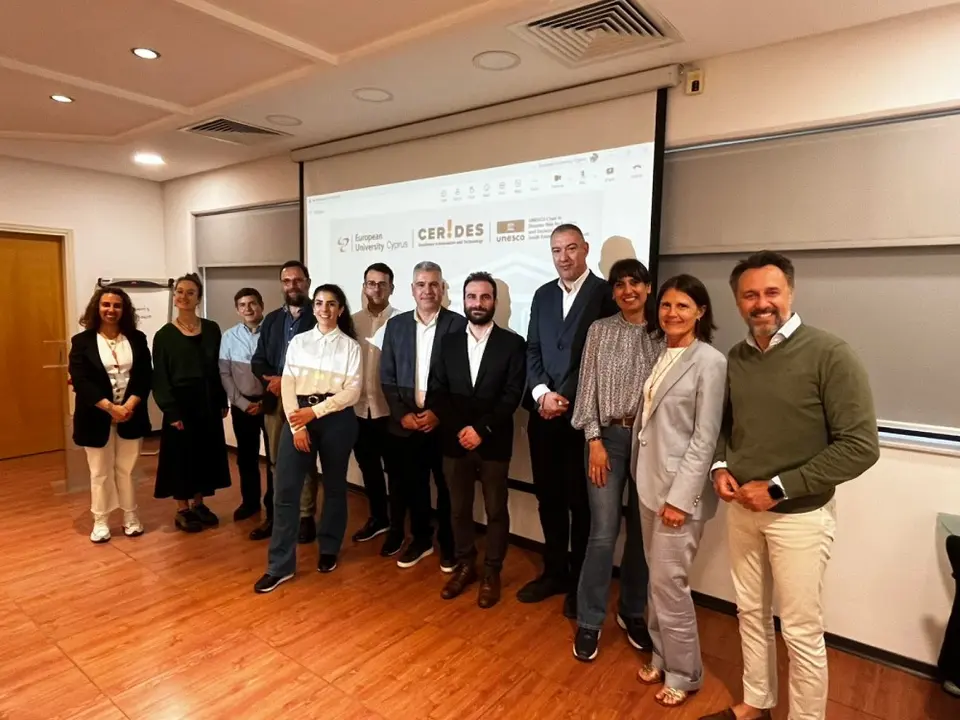
Project partners gathered both in-person and virtually at the European University Cyprus – CERIDES (EUC-CERIDES) in Nicosia for a hybrid kick-off meeting.
EU-DRIVE is an ambitious initiative that focuses in preparing and training citizens for an era of increasing climate and disaster risks. It aims to set a scalable, sustainable model of vocational excellence in disaster resilience for Europe, transforming how the public and the public workforce are trained.
EU-DRIVE brings together 15 Beneficiaries and 4 Associated Partners from Cyprus, France, Greece, Italy, Spain, and Moldova. It adresses the urgent demand for vocational skills in Disaster Risk Management (DRM), civil protection, and climate resilience. The project unites VET-providers, research centres, universities, and public policy actors to co-create innovative, inclusive, and labour market-relevant training solutions.
A Powerful Transnational Alliance
Disaster Risk Management (DRM) and civil protection require seamless cross-border collaboration and cutting-edge skills. To meet this urgent demand, EU-DRIVE unites a consortium of 15 Beneficiaries and 4 Associated Partners across six countries: Cyprus, France, Greece, Italy, Spain, and Moldova.
By bringing together Vocational Education and Training (VET) providers, research centers, universities, and public policy actors, the project bridges the gap between academic expertise and real-world operational needs.
From Strategy to Action: Regional Skills Hubs
EU-DRIVE is built around concrete, localized action. At the heart of the project is the creation of five Regional DRM Skills Hubs alongside a transnational Alliance. These hubs will foster permanent cooperation between emergency services, local authorities, VET institutions, and civil society on training and education.
Leveraging deep territorial roots and specialized expertise in wildfires, floods, drought, and cross-hazard resilience, the partner network will roll out:
Modular Curricula & Micro-credentials: Flexible, certified training tailored to the defined demands of the project’s selected target groups.
Next-Gen Training Tools: Integrating Virtual Reality (VR) and Geographic Information Systems (GIS) for immersive learning.
Work-Based Learning (WBL): Getting trainees out of the traditional models of education and into real operational and working environments.
Insights from the Project Coordinator
The project is led and managed by Prof. George Boustras, Director of CERIDES, who holds overall responsibility for the initiative's execution and strategic direction.
“We have done an enormous and amazing job to get here. This is a truly collective experience where everyone has contributed, and I am incredibly proud of the teamwork that brought us to this launch.”
Project Coordinator
Setting the Groundwork in Nicosia
The two-day kick-off meeting was highly productive, charting the course for the six core work packages that define the project’s scope. Beyond detailed technical and administrative discussions, the consortium reached its first collaborative milestones: officially voting on the project’s new visual identity and logo and formally appointing the members of the steering and management committees.
“The extreme weather effects produced by climate change are transforming it into a full-blown climate crisis. They are making a real, unfortunate impact on our lives, and we are here to cover that gap with EU-DRIVE.”
Project Coordinator
Funded by the European Union. Views and opinions expressed are however those of the author(s) only and do not necessarily those of the European Union or the European Education and Culture Executive Agency (EACEA). Neither the European Union nor EACEA can be held responsible for them.
