
Cyprus focus group advances EU-DRIVE training framework
-
Policy Roundtables
Stakeholders from civil protection, local authorities, and the private sector addressed critical skills gaps in wildfire, flood, and drought resilience.
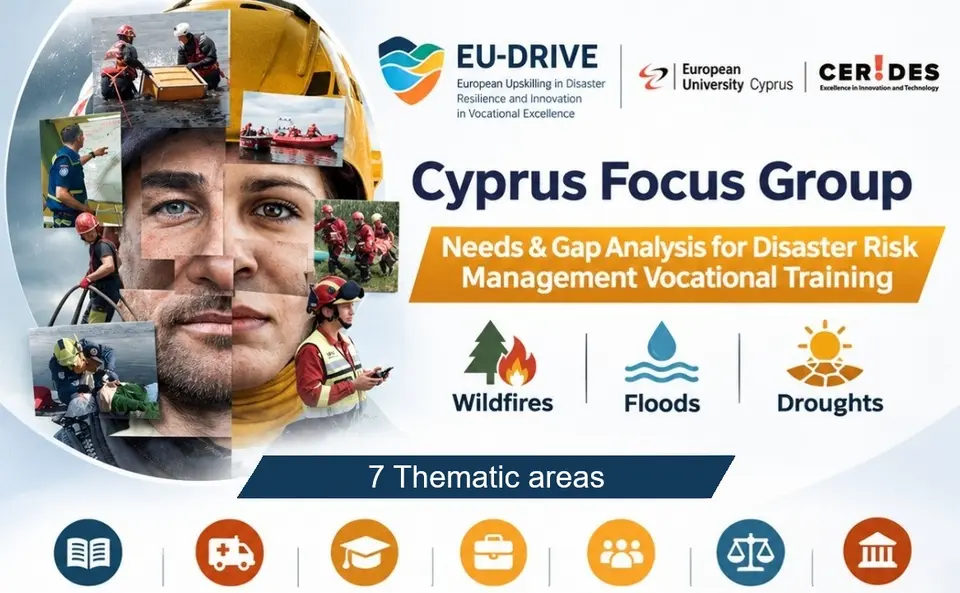
Nicosia, Cyprus | 4 September 2026 — As part of the ongoing stakeholder co-design process across Southern Europe, European University Cyprus(EUC) - CERIDES, organised a national focus group in Cyprus within the framework of the EU-DRIVE project. The session brought together key representatives from civil protection services, local authorities, and the private sector to evaluate training needs and bridge vocational skills gaps in Disaster Risk Management (DRM).
The collaborative discussion centered on pressing climate-induced hazards, wildfires, floods, and droughts, with participants sharing expert professional insights on operational preparedness, emergency response challenges, and the imperative for multi-agency cooperation.
Seven core thematic units
Grounded in EU-DRIVE’s comprehensive methodology, the structured dialogue engaged stakeholders across seven core thematic units:
- Theoretical & Scientific Background: Identifying essential scientific frameworks regarding hazards, vulnerabilities, exposure, and the disaster management cycle.
- Operational Capabilities: Prioritizing critical capabilities across mitigation, preparedness, response, and recovery.
- Skills & Competency Gaps: Examining the balance between technical, digital, and soft skills across all DRM phases.
- Labour Market Alignment: Addressing factors driving the gap between vocational education and training (VET), certification, and employment.
- Community & Engagement: Overcoming challenges in engaging local communities, volunteers, media, and local authorities.
- Policy & Strategy for DRM: Identifying policy gaps across the design, implementation, monitoring, and evaluation lifecycle.
- Multi-Level Governance: Defining key governance priorities spanning local, regional, national, and European (UCPM) frameworks.
Key findings and next steps
The findings underscored an urgent need for enhanced inter-agency coordination, practical field-based training, and updated competencies tailored to emerging climate-related risks. Particular emphasis was placed on proactive prevention, continuous professional development, effective emergency planning, and strengthening community resilience.
Insights gathered from the Cyprus session, alongside parallel consultations conducted across partner regions in France, Italy, Spain and Greece, will directly inform the development of the EU-DRIVE vocational education and training curriculum, supporting more effective, inclusive, and resilient disaster risk management practices across Europe.
Funded by the European Union. Views and opinions expressed are however those of the author(s) only and do not necessarily those of the European Union or the European Education and Culture Executive Agency (EACEA). Neither the European Union nor EACEA can be held responsible for them.
